
If you’ve been in the mobile consumer space long enough, you know a painful truth: true virality has been basically dead since the early Facebook Canvas days.
The reason is simple: the standard App Store funnel is a virality killer. It’s not that any single step is difficult, but the cumulative friction of so many stages - seeing a link, navigating to a storefront, downloading the app, creating an account, and then trying to find the friend who invited you - is simply too high for organic loops to take off.
By contrast, on Jest the recipient just taps a link. The app loads in their browser in seconds, and Jest already knows who referred them. This frictionless flow reclaims true virality.
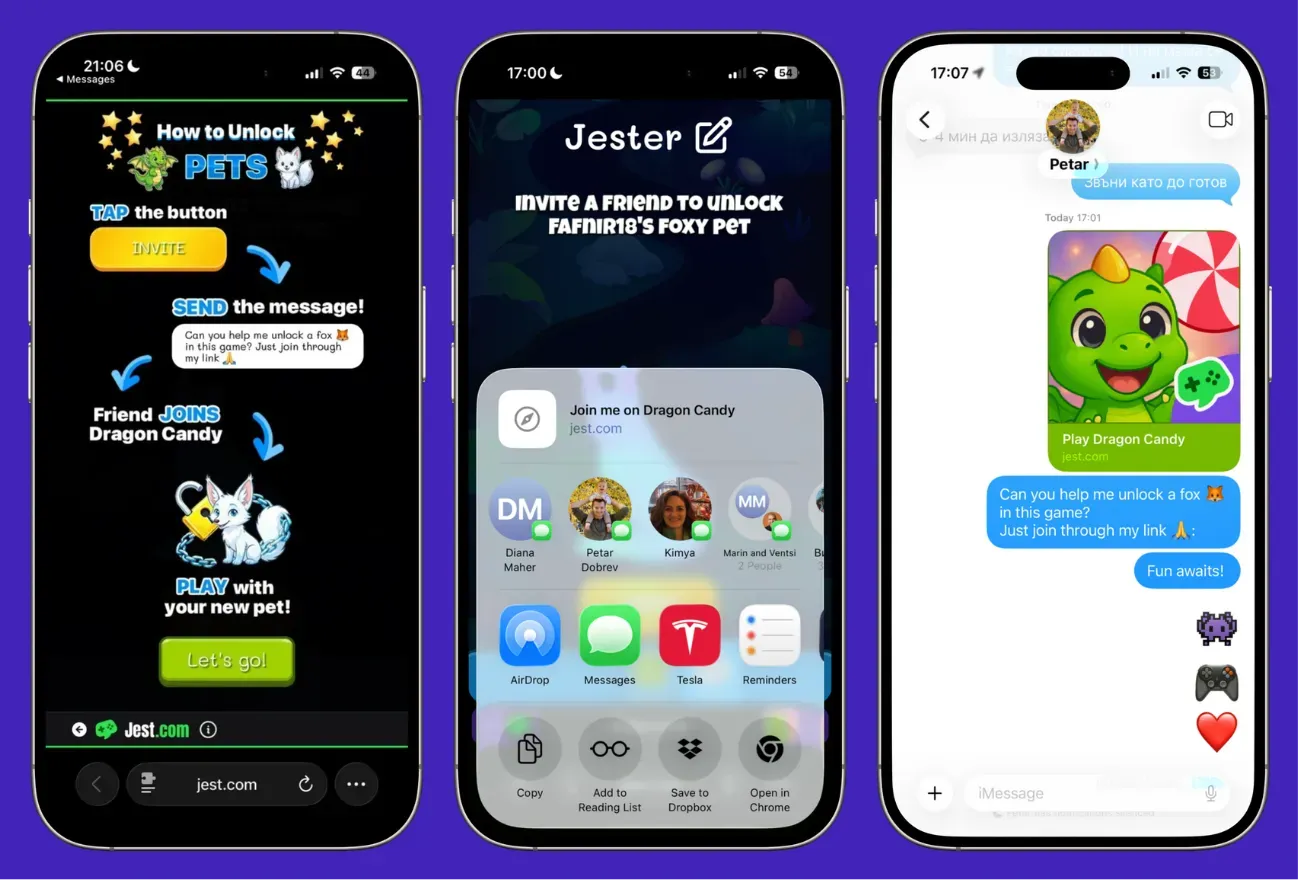
We recently ran our first major test to see if this hypothesis held up, and the results were highly encouraging.
The proof is in the data
In our recent test, we saw the kind of organic growth loops that most mobile apps haven’t experienced in over a decade. Here is what the results looked like:
25% Share Rate
One in four players actively invited their friends, turning the user base into a growth engine.
1:2 Referral Ratio
This wasn’t just 1-to-1 growth; every player who shared brought in an average of two new users.
2x Conversion
Invited users converted into messaging subscribers at twice the rate of our ad-driven benchmarks.
+50% D7 Retention
The cohort of organically invited users retained 50% higher than users acquired through ads.
📉 30% Drop in Blended CAC
Because of this heavy influx of high-quality organic users, our overall blended Customer Acquisition Cost plummeted by 30%.
This is a fundamental shift in unit economics. But to replicate this, you have to build for the right kind of virality.
The Jest virality framework
True virality is a misunderstood art, largely because so few developers have seen it work at scale since the golden era of social gaming. I had the chance to witness it firsthand during my time as CMO of the instant gaming unicorn Playco. Drawing on that experience, I’m sharing this playbook to help all Jest developers navigate the platform, avoid common pitfalls, and maximize their success.
The three types of virality
There are three types of virality that often get mixed up:
1. Soft Virality (The “Share” Button)
- Example: A passive button sitting in the UI that says “Share your high score.”
- Verdict: This approach basically does not work. Users have developed banner blindness to generic share buttons. Unless sharing is core to the app experience, this won’t move the needle.
2. Within-Network Virality
- Example: An existing Jest game user stealing gold from another Jest game user.
- Verdict: Within-network sharing is fundamentally a retention tool rather than an acquisition tool. Since Jest’s retention is already exceptionally strong, we are focusing our immediate efforts on the acquisition-driven goals detailed in the next point.
3. Outside-Network Virality (The Golden Ticket)
- Example: A Jest user inviting a non-Jest user via a message to join the platform and play, compete, or collaborate.
- Verdict: This is the key area we are prioritizing. The friction required to bring an external friend into a Jest environment is incredibly low compared to the hurdle of a standard app download. We encourage all Jest developers to lean into this advantage by building mechanics that actively reward players for inviting their outside friends into the game.
Best practices for designing viral mechanics
If you are designing an app or game for Jest and want to optimize for outside-network virality, keep these core principles in mind:
- Give them something meaningful: Make the reward for sharing substantial within the context of the app. In our recent test, we locked an entire mini-game until the player invited a friend who successfully joined Jest.
- Make it a regular occurrence: Ideally, sharing mechanics shouldn’t be a one-off event. Design them to be repeatable so your most loyal players can continuously invite new friends over time.
- Always bet on async over sync: Synchronous multiplayer sounds great on paper, but on mobile, it is notoriously difficult to coordinate. Asynchronous gameplay (think taking turns or contributing to a shared goal on your own time) is infinitely easier to scale and fits perfectly into natural messaging habits.
- Leverage cooperation or competition: Both can work, but they serve different audiences. Competition (PvP, leaderboards) is powerful but tends to be more hardcore and thus niche. Cooperation (playing on a team, pooling resources) often has broader appeal and naturally encourages users to invite friends to help them succeed. Choose what natively fits your core game loop.
Start building
To help you seamlessly integrate these viral loops, we recently released the Referrals API. By attaching an entryPayload to referral links, you can carry custom data directly into a new player’s first session - making it easy to provide personalized rewards and track exactly which invites converted.
Check out the documentation here: https://docs.jest.com/sdk/html5/referrals.
We also added a new virality guide, which you can find here: https://docs.jest.com/guides/virality.
We expect to create more virality-related APIs in the near future to give developers even more tools to grow. If you have ideas or specific needs, we always welcome your suggestions!