Over the past few days, we’ve crossed a quiet but important milestone: 1,000,000+ text messages sent across the Jest platform, powered by the new RCS messaging protocol.
Not marketing blasts. Not one-off campaigns. But product-integrated communications, triggered, scheduled and continuously experimented on as part of the core user experience.
Here are three surprising lessons that held up under real experimentation.
1. The Messaging Inbox Is the Most Underrated Product Surface
Let’s start with the obvious question: do users actually engage when notifications are sent as text messages?
To ground this, it’s helpful to compare against common mobile engagement benchmarks:
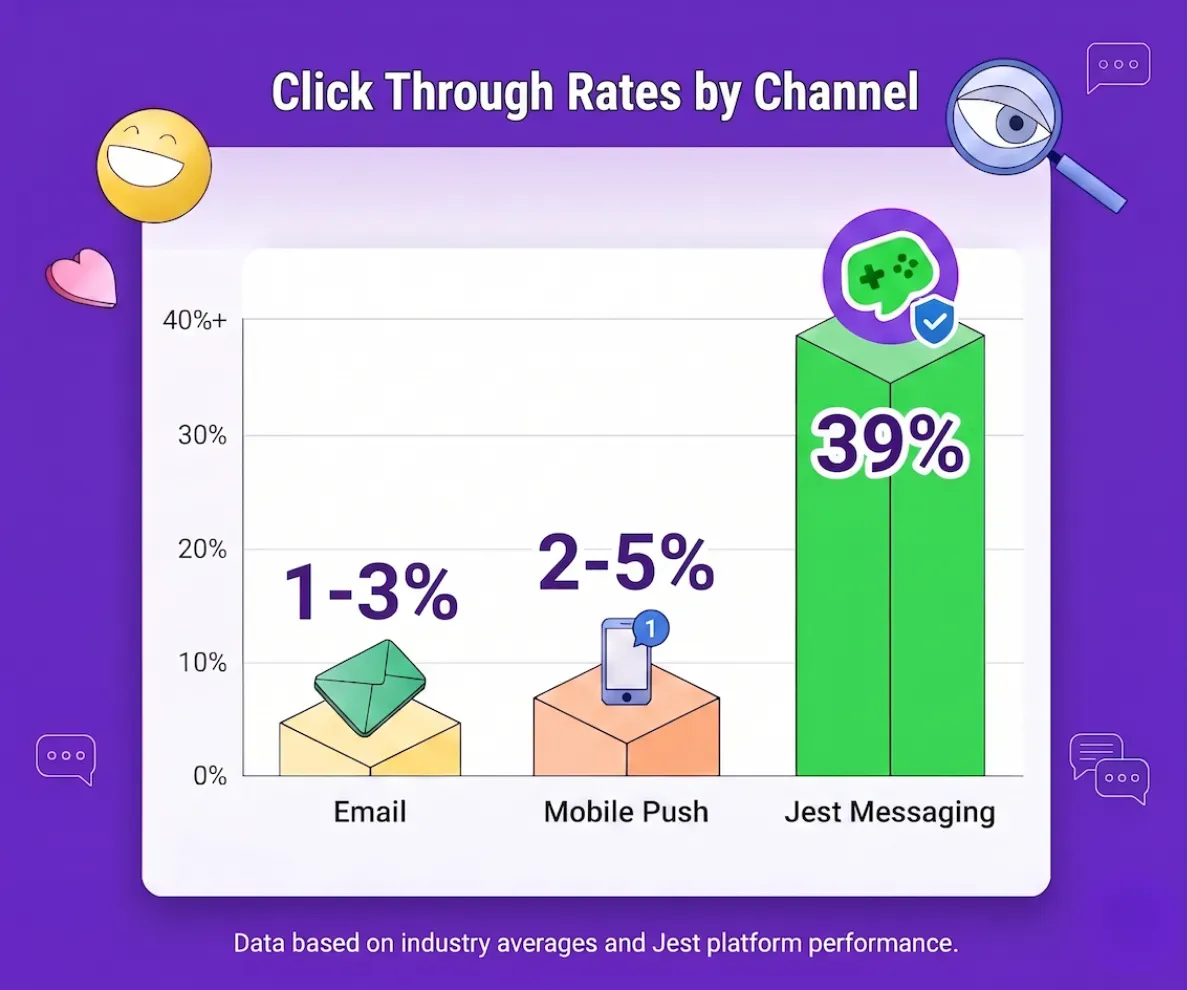
Over the past 90 days, our average CTR on messages is 39%, with some apps consistently 50%+. This isn’t a marginal lift - it’s an order-of-magnitude difference with often 10–20x higher engagement than traditional channels.
Why? Because the messaging inbox isn’t just another channel. It’s a primary interface. It’s where users already spend time, already pay attention, and already respond.
No install friction, no competition from dozens of apps in a notification tray. Just a message delivered to the place people check the most.
2. Timing Is a First-Class Product Lever
If open rates answer whether users engage, timing answers when they engage. And the answer is: almost immediately.
When do users engage with Jest messages?
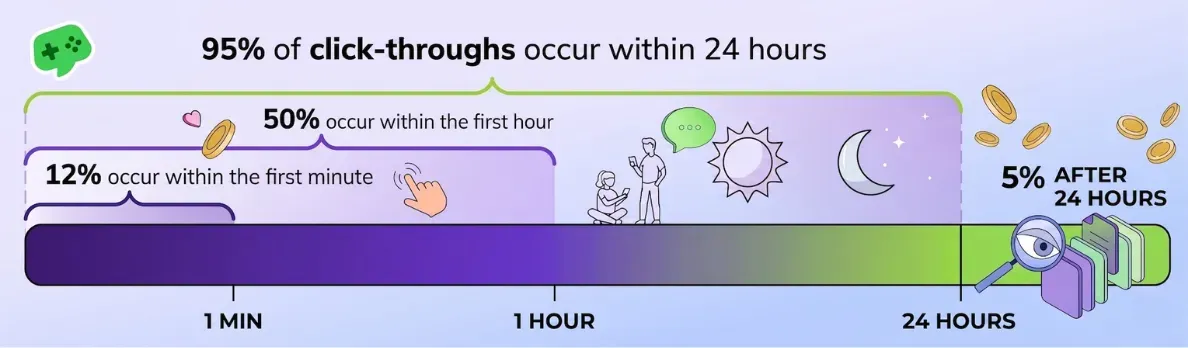
This is not passive engagement. It’s reactive. A message isn’t just a reminder - it’s a trigger. We’ve learned you can quite literally shape user activity in real time by changing when messages are sent.
We’ve seen that small shifts in timing can meaningfully change downstream behavior. As a result, we treat timing not as a configuration detail, but as a core product lever - and are continuously experimenting on it.
3. Pinning Effects Shape Long-Term Engagement
One of the more subtle but powerful dynamics we’ve observed is what we call pinning effects.
Unlike push notifications, browser sessions and messaging threads are persistent surfaces. They don’t disappear after interaction - they remain available and naturally resurface throughout the day.
This creates two natural re-entry loops:
Browser Pinning Effect
Users move in and out of their browser constantly. When they return to the web, they’re dropped back into their last active tab. If that tab is Jest, it becomes a passive re-entry point into the product.
The same is true when users scan open tabs and recognize a recent Jest session - they may organically re-enter without an explicit prompt.
Messaging Pinning Effect
Messaging behaves similarly, but with even stronger durability. Users open their messaging app multiple times a day, and Jest sits among a stream of conversations with friends and family - often near the top, with recent context still visible.
And unlike push notifications, messaging threads don’t disappear. They accumulate. Over time, what starts as individual messages turns into a continuous thread of interaction with the product; a lightweight history users can scroll back through to find their favorite apps and re-enter the experience at any time.
Together, these effects show up in our session source data:
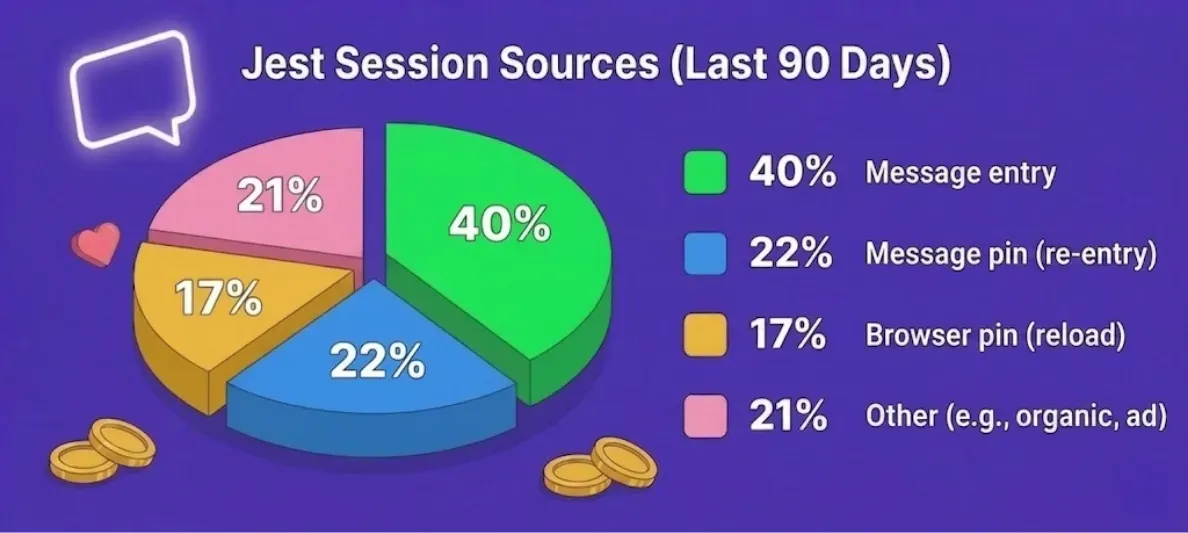
Notably, a meaningful share of sessions come from message re-entry - that is, users tapping on messages for the second, third, or later time - behavior that wouldn’t exist in an ephemeral push-based system.
Browser pinning shows up in reload-driven sessions, where users return via previous tabs.
Experimentation Is the Product
We’re still early, and we’re excited to keep experimenting with new concepts, from advanced timing models and multi-send strategies, to cross-app personalization and new notification formats that blur the line between message and gameplay.
One pattern is already clear: messaging is not just a distribution channel for notifications. It’s a durable product surface with its own interaction loops.
The implication isn’t just better engagement rates; it’s a shift in where the product actually lives in the user’s daily flow.