
A player’s first few minutes in your game decide whether they stay, sign up and come back tomorrow. Game designers call this the first-time user experience, or FTUE. This guide is our suggested approach to building a great one on Jest, drawn from Jest’s docs, our own onboarding tests, and what we’ve seen playtesting games on the platform. Think of these as strong suggestions, not hard rules. Results vary by game.
The mockups all use one sample game, the same one from our sign-up guide.
Why the First Five Minutes Matter More on Jest
On the app stores, installing works as a filter. By the time someone opens a new app, they’ve seen an ad, maybe tried a playable, and waited through a download, so they’re already invested.
On Jest, a player taps an ad and is in the real game right away. That’s a better experience, but it means a first-time player arrives more skeptical. Your first few minutes have to do the job the install used to do.
- Players decide fast. Jest’s own data shows 84% of registrations happen within the first five minutes of a player’s first interaction.
- Registration is what brings them back. Guests can’t receive notifications. In one game on Jest, registered ad players came back the next day at 45%, against 4% for guests.
- It’s part of review. Every app is played by someone on the Jest team, and it can fail for broken or dead-end flows, confusing controls, or poor legibility.
Adapting a game that already exists? The FTUE is usually the part to rework. A first session built for app store players, who arrived already invested, often teaches too little or pays off too late for Jest.
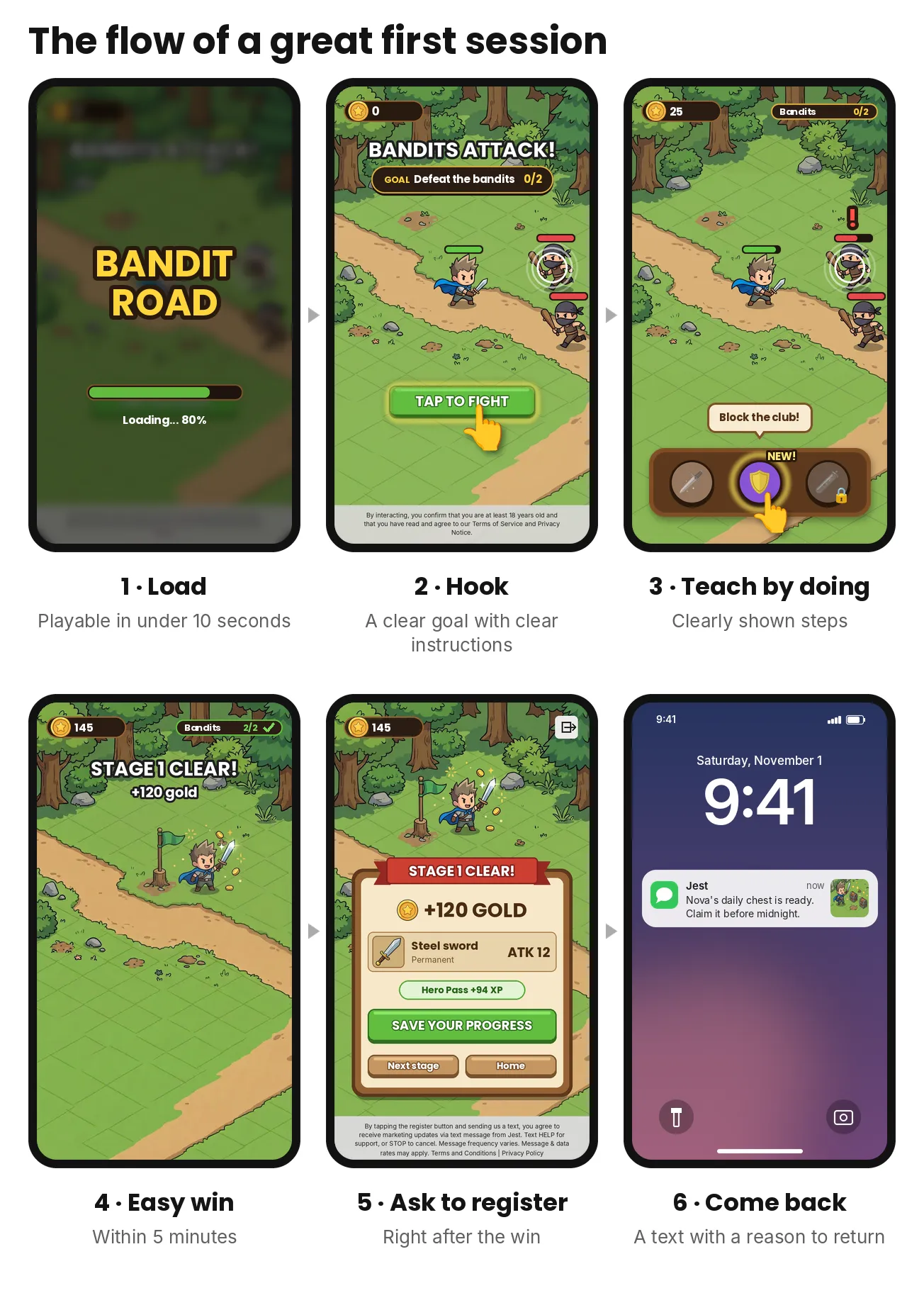
The flow of a great first session: load, hook, teach by doing, easy win, ask to register, come back
Every step builds toward the ask. By the time you ask players to register, they have a win they don’t want to lose, and registering unlocks the notifications that bring them back tomorrow.
Tutorials: Yes, Please
Every game should have a tutorial. The best ones don’t feel like tutorials at all: the player learns by playing, not by reading.
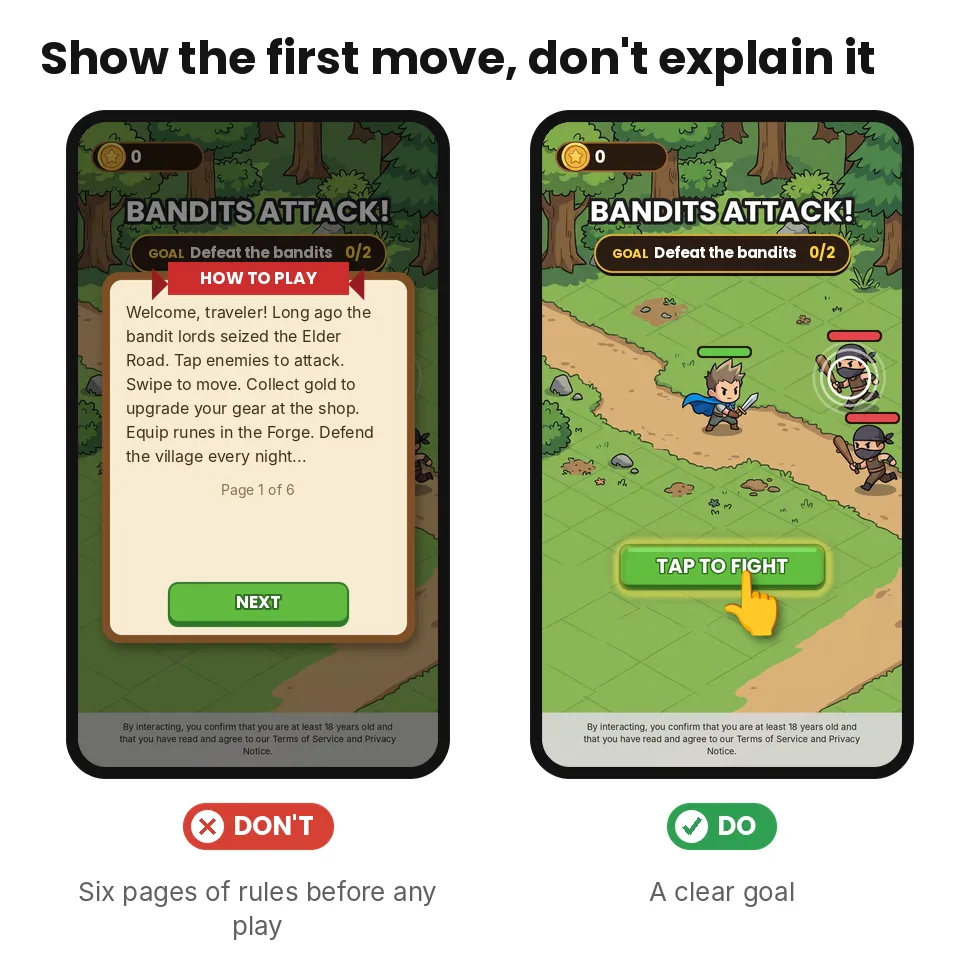
Don’t open with a wall of rules. Do show a clear goal.
Teach in this order: instruction, action, feedback, reward. Instead of a text box that says “Tap the sword button to attack,” make the button glow and point a hand at it. The player taps, the enemy takes a hit, and gold pops.
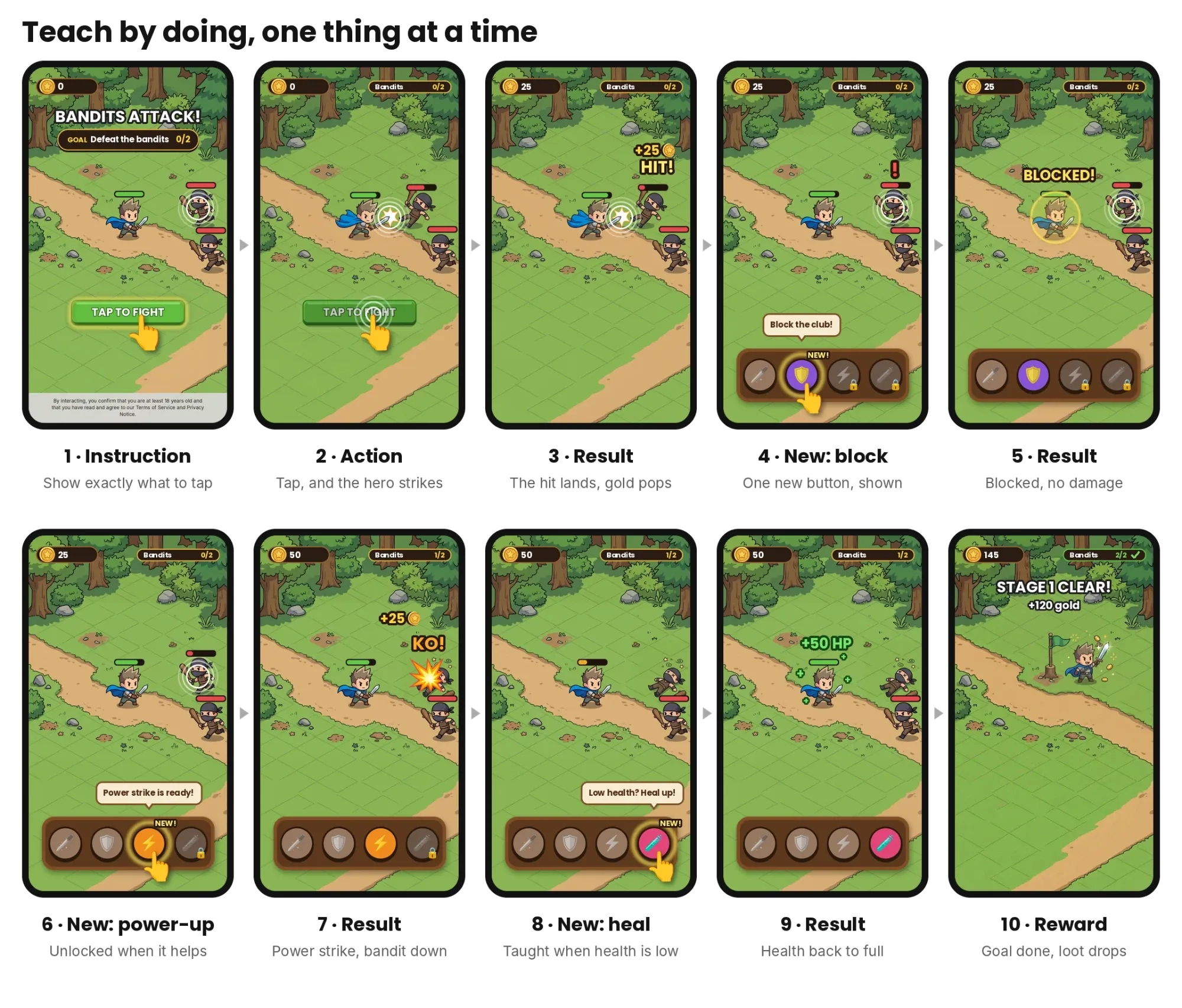
Teach by doing: instruction, action, feedback, reward
What a good tutorial looks like:
- Show the goal first. The player should know what they’re working toward: beat the boss, clear the board, serve the first customer, fill the meter. Then cover the essentials: what they collect or spend, what happens when they fail, and the controls.
- One mechanic at a time. Introduce each new thing when it’s needed. Hide the shop, crafting and menus until the player is ready, then unlock them one by one.
- Show, don’t tell. Use a pointing hand, a glow or an arrow on the exact thing to tap. Keep any text to a few words.
- Clear feedback on every tap. Sound, a bounce, a number popping up, a bar filling. The player should never wonder if something worked.
- Real choices, even small ones. “Tap here, now tap here” gets boring fast. Let the player pick a character, a power-up or their first upgrade.
- Keep the first minutes guided. Limit choices that could set a new player back, like spending currency on the wrong upgrade, so every player reaches the first win on time.
- It should feel like they could lose, but they can’t. Guide the outcome so a new player wins, while it still feels earned.
- Save tutorial progress. A player who leaves mid-tutorial should pick up where they left off. In one game on Jest, about 60% of players who came back mid-tutorial never continued.
Hook Them With an Easy Win
Give every new player a big win within their first five minutes. It’s the moment they decide your game is fun, and it gives them something worth saving when you ask them to register.
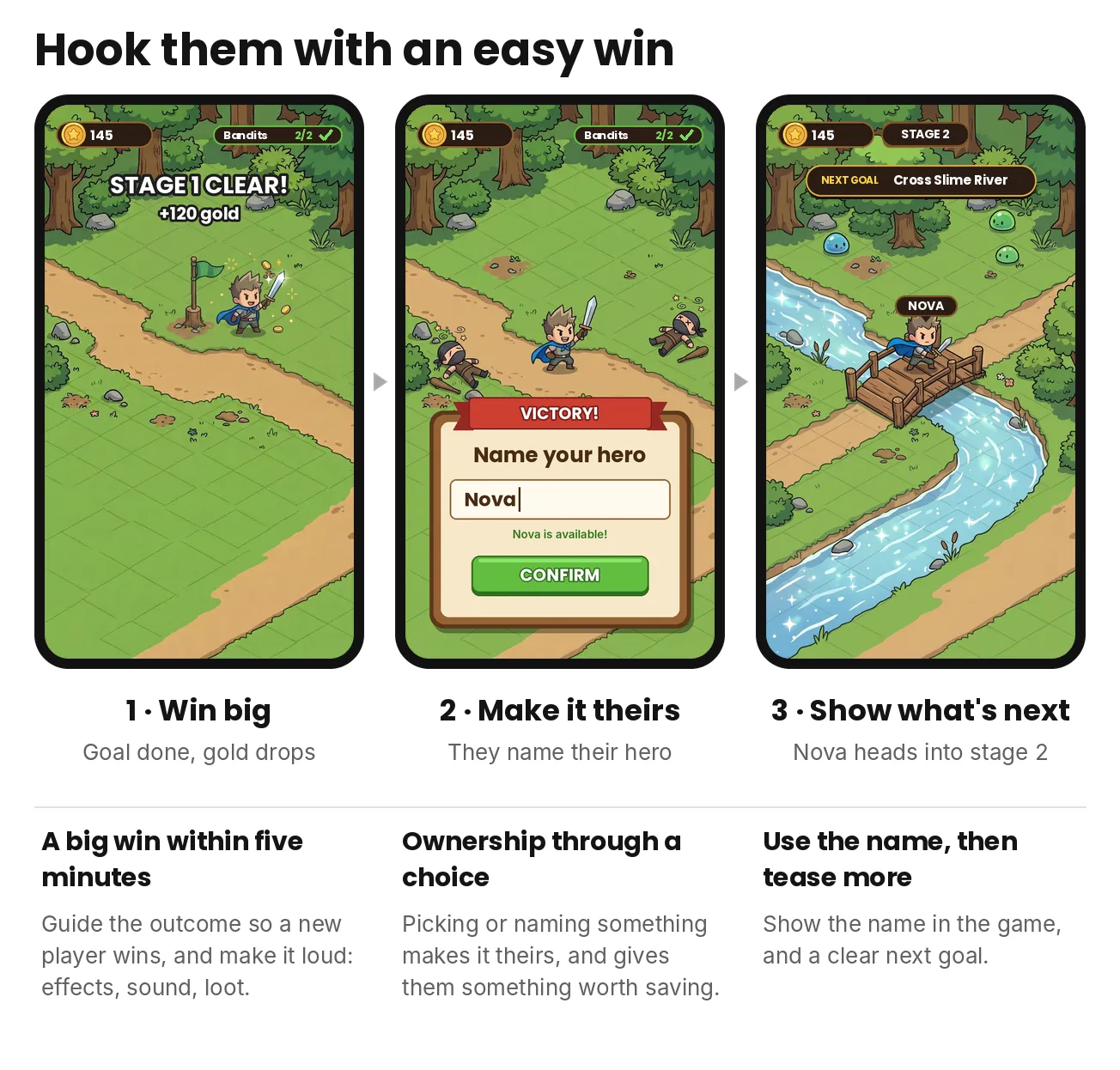
Hook them with an easy win: win big, make it theirs, show what’s next
Get to the fun fast. Drop players straight into your core mechanic. Lore, long cutscenes and feature tours can wait.
Make the win feel big. Celebrate it with sound, effects and a reward that matters: a rare item, a new character, a creature hatching, a level cleared.
Tune the clock, not the ask. If your first big win takes longer than about five minutes, make that stretch easier or shorter rather than moving the ask earlier. That way the ask still lands right after a win.
Let them make it theirs. Picking a character, a pet, a look or a team, then naming it, creates ownership. Then use that name in the game. In Jest’s own sign-up tests, removing the name step roughly doubled the cost per sign-up. When to offer it depends on your game: some games open on it, like naming a pet or a shop, while others do better dropping players straight into play and offering it right after the first win, paired with the ask.
Show what’s next. Tease the next goal, the next world or what they can unlock. A player who can see where the game goes has a reason to keep going.
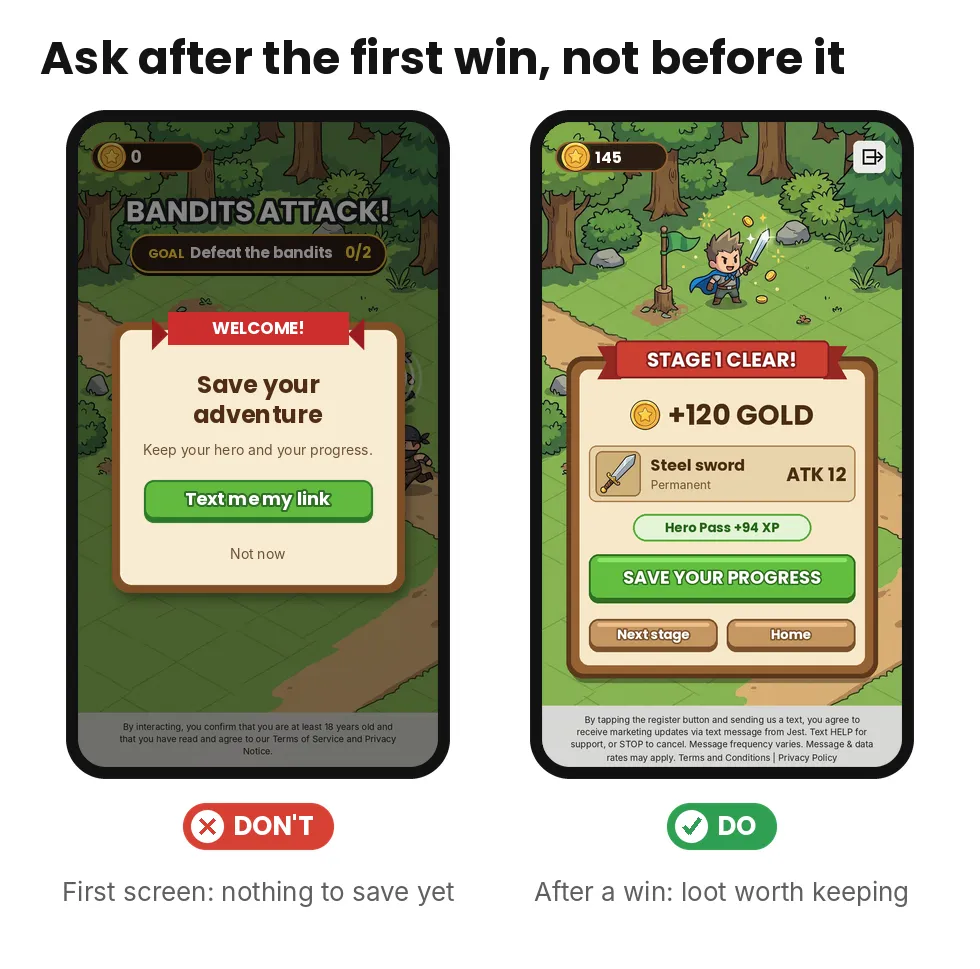
Ask after the first win, not on the first screen
- Time it to a peak moment, within the first five minutes: right after the first win, a rare reward, or a creature hatching.
- Keep the ask simple: the thing they earned, one line of copy, one clear button.
- Track it. Log your own event when the ask shows, so you can see where players drop.
Registration isn’t separate from your FTUE. It’s the payoff of it: the tutorial and the easy win build something the player cares about, and the ask lets them keep it.
For sign-up patterns, button copy and the pre-filled text message, see Getting Players to Sign Up: A Jest Registration Guide. For setup and code, see Platform login in the Jest docs.
Bring Them Back
- Schedule the D1 to D7 notification sequence as soon as a player registers.
- Leave a reason to return before they leave: a daily reward, a timer, an egg about to hatch, tomorrow’s puzzle.
A Few Things to Avoid
- Making players wait. Long loads, splash screens and unskippable intros lose players before they’ve tapped anything. Apps must be interactive in under 10 seconds on a standard mobile connection, and faster is better.
- A game over for a brand-new player. Let it feel risky, but guide them to the win.
- Resetting progress on sign-up. Losing what they just earned is the fastest way to lose a new player.
- Pointing players outside Jest. No links or CTAs to other sites, apps or email sign-ups. This fails review.
Before every submission, play your own first five minutes as a brand-new guest, on a phone. If you’d hand over your phone number at the end of it, your players probably will too.