
Thanks to AI, more people are making apps than ever before. A creator with a good idea and a weekend can now get surprisingly close to something that once would have required a whole team.
Some of the most popular apps on Jest have already been built, expanded, and managed with AI playing a significant role. We expect even more people to start building and we think that’s super exciting.
But there’s a catch: making something is easier. Making something good isn’t.
When the cost of making an app changes from a team and a year to a creator and a weekend, the number of apps goes up dramatically. And when more things get made, the bar for standing out goes up too.
It’s tempting to accept defaults as good enough, to ship the happy path, and to stop when the game technically works.
But users don’t care how hard something was to build. They care whether it’s fun.
At Jest, we review a lot of apps, including many built heavily or entirely with AI. We’ve started seeing some of the same issues over and over again, so here are a few things we recommend keeping in mind.
1. Would I actually play this?
AI can get you to a game that runs remarkably quickly. But have you actually played it all the way through from the user’s perspective?
Play it yourself. Give it to five friends. Don’t explain anything. Watch where they get confused, bored, or frustrated. Then fix those things and play it again.
Ask yourself: Would I actually play this? Would I send it to a friend today?
2. Love the first 60 seconds
AI is great at getting to the core loop, but it’s easy to forget about the first-time experience.
Can someone immediately understand what to do without you explaining it? What are the 3-5 things you want them to understand or experience in their first few minutes?
Hand your phone to someone who’s never seen your app, say nothing, and watch what happens in the first minute. Whatever confuses them is useful information. Oh, and check out our guide to designing a great first-time user experience.
3. Test beyond the happy path
Did you tap every button? Try losing? Quit halfway through? Start over? Come back later? What happens with an empty state or an error? Does progress save?
AI is very good at the happy path. Users are very good at finding everything else.
And while you don’t need to write every line of code yourself, you should understand what you shipped.
4. Make deliberate design choices
We’ve seen some recurring UI issues in AI-assisted apps: unnecessary copy, tiny fonts made for ants, excessive whitespace, inconsistent art styles, and confusing interactions.
AI also has some recognizable defaults, like rounded cards, nested containers, everything centered, and gradients everywhere. These aren’t inherently bad. The point is to make sure you’re choosing them because they’re right for your game, not because they’re the default.
Spend some time giving your game its own visual language. Cut redundant text. Keep the art cohesive. Make the interface feel intentional.
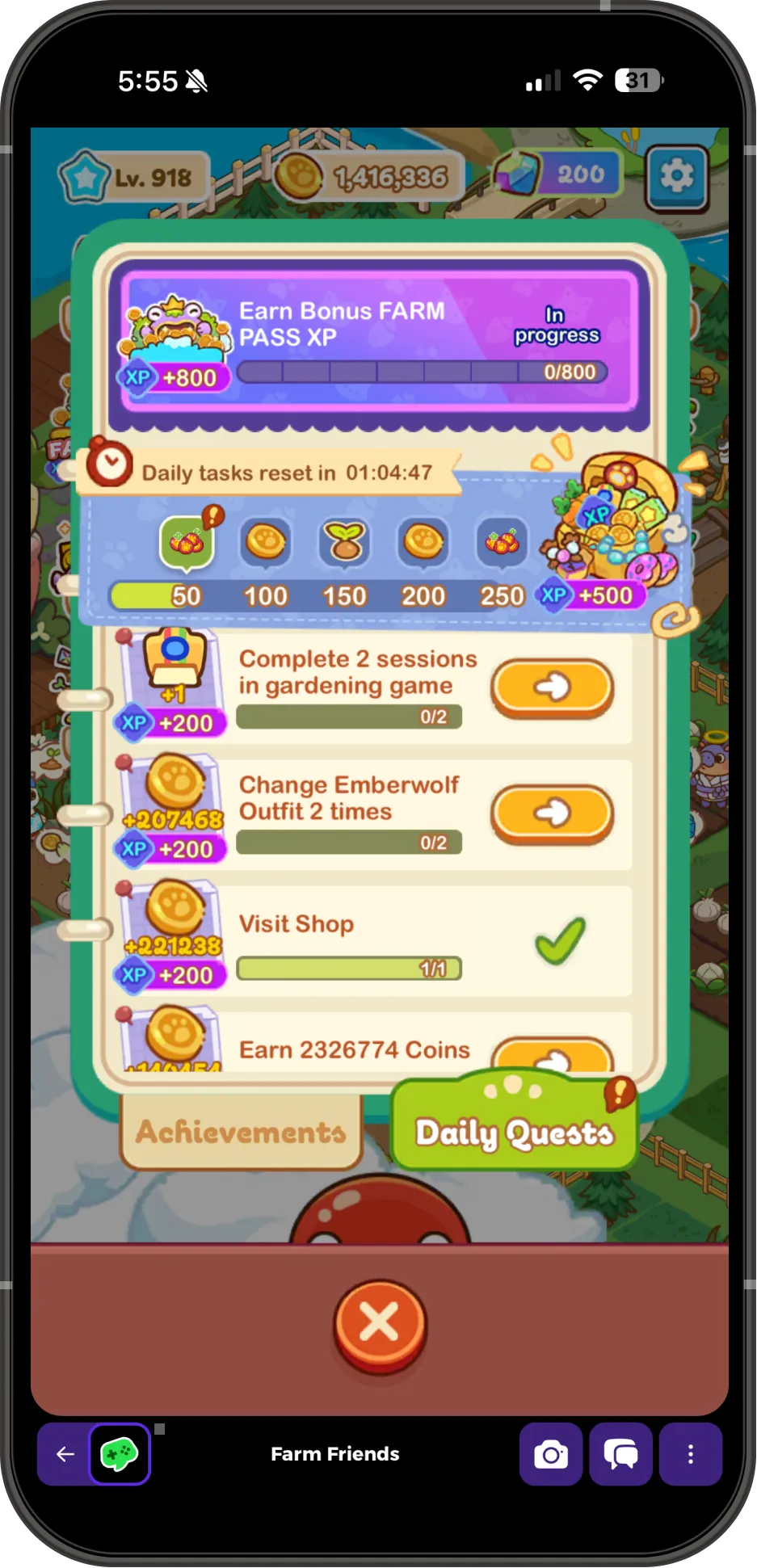
Farm Friends, live on Jest. Every detail is intentional: the reward chips break out of their frame, the active tab stands out, copy is readable at a glance. Small decisions add up.
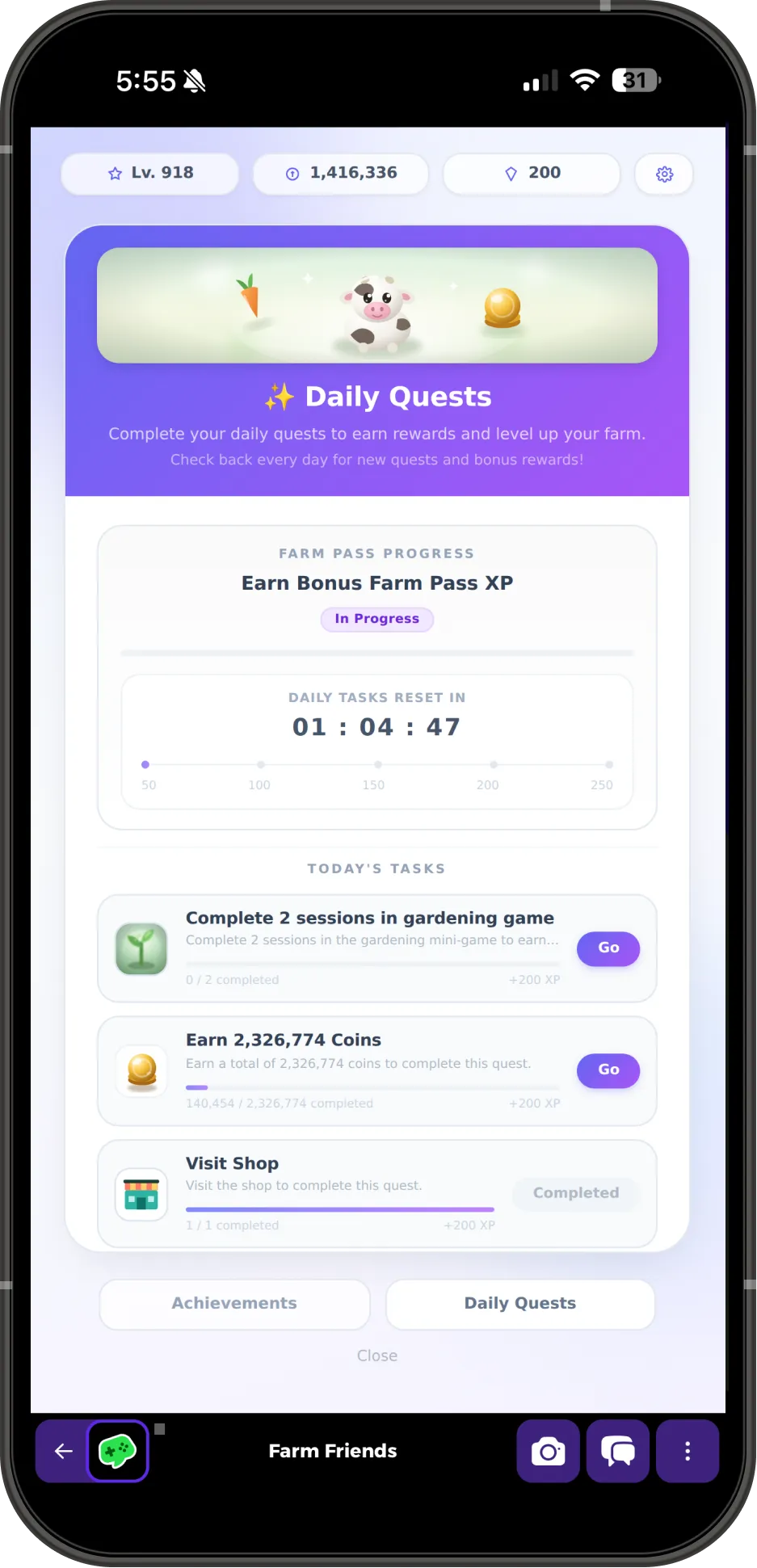
The same screen, mocked up with AI defaults. Gradient header, cards inside cards, over-centering, and too small font. It works, it just hasn’t found its own visual language yet.
AI is the accelerator. You’re still the driver.
We think AI is an incredible tool for code, content, art, iteration, and all the other laborious parts of development. But taste, design, creativity, storytelling, and knowing whether something is actually fun still need human judgment.
The opportunity isn’t to make fewer things with AI. It’s to make better things, faster.
The door is open to everyone. The bar is simply: make something people want to play.
Our developer docs are open to everyone, team or no team!